
Why Gardening Is an Important Skill for Preppers, Homesteaders, and Self-Reliance
Growing Your Own Food Is More Than a Hobby — It Is a Foundation of Preparedness
When people think about disaster preparedness, they often picture emergency food supplies, water storage, generators, and go bags. While these are important parts of a preparedness plan, there is another skill that deserves just as much attention: gardening.
Gardening is one of the most practical skills a person can learn when working toward preparedness, readiness, and self-reliance.
Whether you consider yourself a prepper, a homesteader, or someone simply looking to become less dependent on outside resources, the ability to grow food provides benefits beyond fresh vegetables.
It teaches planning, resource management, patience, problem-solving, and an understanding of the natural systems that support our everyday lives.
A pantry helps you prepare for tomorrow. A garden helps you develop the ability to provide for the future.
Understanding Gardening in Preparedness, Readiness, and Self-Reliance
Although these concepts are connected, each approaches gardening from a slightly different perspective.
Gardening for Disaster Preparedness
Disaster preparedness focuses on developing plans and gathering resources before a disruptive event occurs.
For a prepper, gardening provides another layer of food security. A productive garden can supplement stored food and reduce reliance on grocery stores during normal growing seasons.
Natural disasters, transportation interruptions, economic difficulties, and disruptions to food distribution can affect access to fresh produce.
Growing some of your own vegetables can help reduce that dependency.
However, gardening is not an immediate replacement for stored emergency food. Crops require water, suitable weather, time, labor, and healthy growing conditions. An established garden should complement an emergency food supply, not replace it.
Gardening for Readiness
Readiness is the ability to put knowledge, resources, and skills into action when needed.
Owning seeds and gardening tools does not necessarily mean you are ready to grow food.
Readiness comes from actually practicing the skills.
Can you identify suitable planting conditions? Can you recognize when your plants need water? Can you address a pest problem, improve poor soil, or adjust after a failed crop?
A person who gardens regularly develops experience that cannot be gained simply by purchasing supplies.
The best time to learn how to grow food is before you must depend on the harvest.
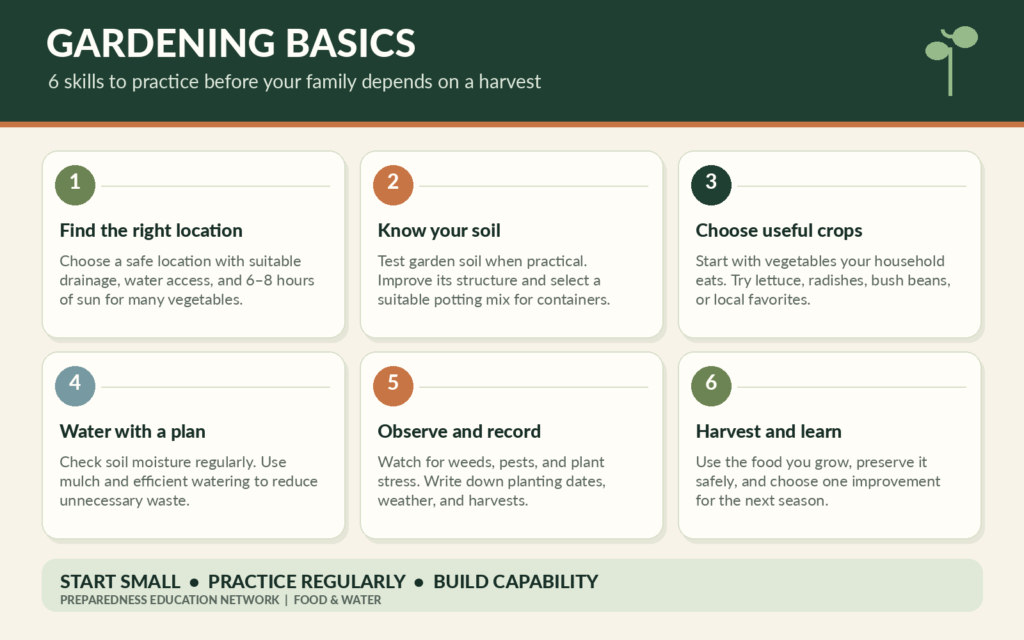
Gardening Basics: Where Should Beginners Start?
When Should Preppers, Homesteaders, and Self-Reliant Gardeners Plant?
One of the most important lessons in gardening is that planting dates depend on your local climate and the crops you are growing.
A planting date that works in Florida may be completely unsuitable for Colorado, Minnesota, or Montana.
The following seasonal guidelines apply broadly to temperate Northern Hemisphere climates. Warmer and frost-free regions may have different planting cycles.